Rybicod
Lattice Series
Lattice Series
Couldn't load pickup availability
Self-paced learning overview
- ⬇️ Digital file available after purchase
- 📚 Long-term availability
- 🔒 Secure checkout
- 🗓️ Content updated in 2026
1. Problem Statement
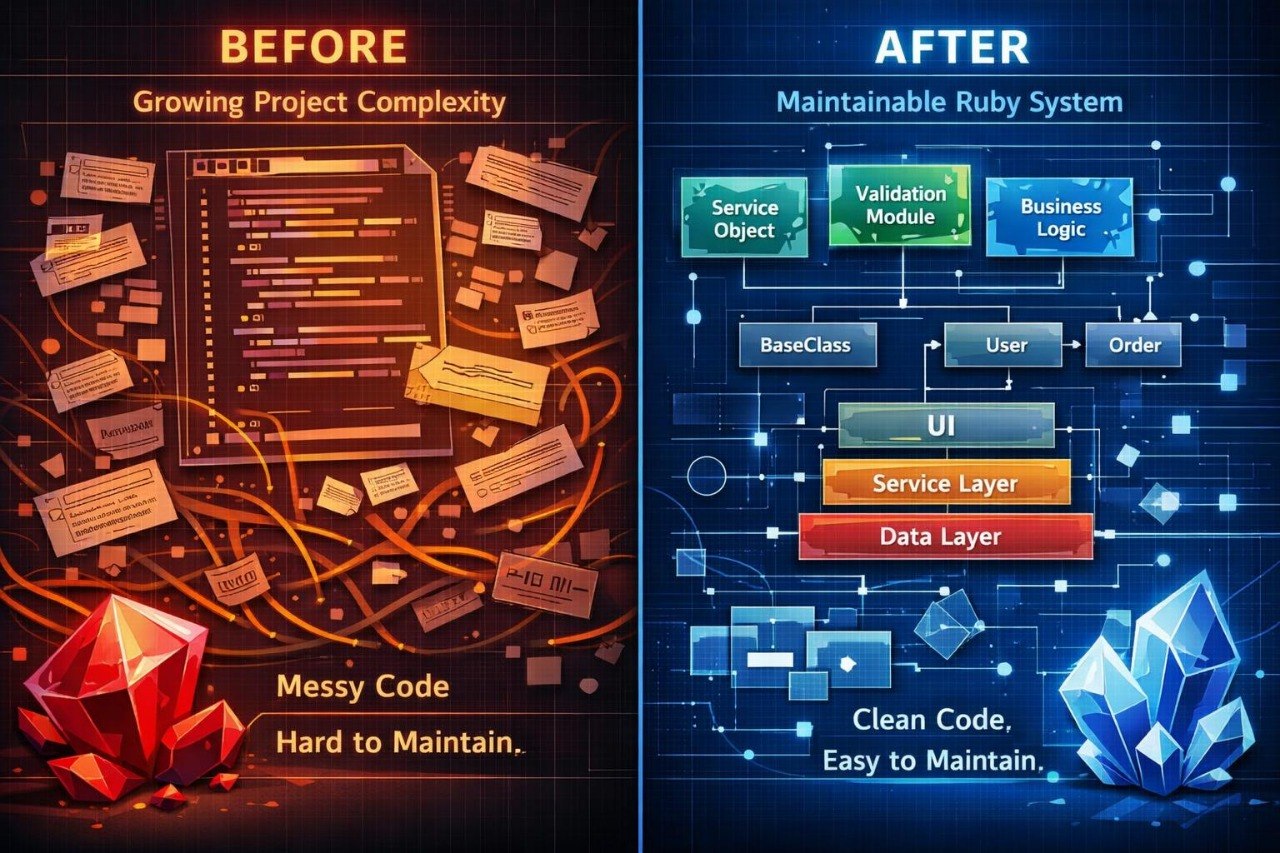
Struggling to keep a growing Ruby project organized across multiple classes and files? You're not alone. As a learning project expands, separate classes may begin handling too many tasks, while the connections between them become difficult to follow. Methods may repeat, data may move between program sections without a clear route, and a change in one place may affect several others. This can make code harder to read, review, and understand in execution order. Lattice Series helps you build a more considered system of connections across a Ruby project.
2. Solution
This course will teach you how to organize a broader Ruby project through clear roles, reusable modules, and connected data flows. You will work with object composition, modules, namespaces, division of responsibility, and data review between different program sections. The materials show how to create connections without excessive dependency between classes. Each module adds a new structural element and explains its place in the wider arrangement. Lattice Series is suitable for learners who want to view a Ruby project as a network of connected but separately organized components.
3. What’s Inside
Module 1: Mapping the Project Structure — how to create a map of classes, files, and data flows before writing a broader Ruby scenario.
Module 2: Composition Between Objects — how one object can contain or use another object to complete a separate task.
Module 3: Modules for Shared Behavior — how to move repeated behavior into modules and include it in several classes.
Module 4: Namespaces and Code Grouping — how to group related classes and reduce confusion between names.
Module 5: Clear Dependency Paths — how to identify which objects depend on one another and reduce unnecessary connections.
Module 6: Data Validation Layers — how to review values before passing them into the next program section.
Module 7: Service-Oriented Tasks — how to move separate operations into dedicated classes or modules instead of overloading core entities.
Module 8: Reusable Query Logic — how to organize data search, filtering, and selection without repeating conditions.
Module 9: File Coordination — how to place related classes, modules, and supporting sections in a readable file structure.
Module 10: Error Handling Patterns — how to handle incorrect values, missing data, and expected errors in learning code.
Module 11: Refactoring a Connected System — how to review relationships between components and simplify the structure without changing the core logic.
Module 12: Lattice Practice Scenario — a learning project with several classes, modules, checks, data flows, and separate supporting components.
4. Who is this for?
✅ Suitable if you have already worked with several classes and files and want to organize their interaction more clearly.
❌ Not suitable if variables, conditions, and loops are still new to you or if you have not yet worked with Ruby object structure.
5. What You’ll Learn
- Create a map of a Ruby project structure
- Use composition between objects
- Move shared behavior into modules
- Group classes through namespaces
- Identify dependencies between components
- Review data at several stages
- Separate entities from supporting operations
- Organize data search and filtering
- Maintain a clear file structure
- Handle expected errors
- Review and simplify relationships between classes
- Complete a learning scenario with at least four classes and two modules
6. Refund Terms
Lattice Series includes structured course materials for independent learning. If the course does not meet your expectations, you may request a refund within 30 days according to the store policy. This gives you time to review the modules, examples, structure maps, and practical tasks and decide whether the course format fits your learning needs. The complete refund terms are shown on the relevant store page and should be reviewed before placing an order.
1. Who are Rybicod courses made for?
1. Who are Rybicod courses made for?
They are made for learners who want to study Ruby programming through structured materials, code examples, and practical tasks.
2. Do I need previous experience?
2. Do I need previous experience?
No. Starter plans are suitable for exploring the basics, while higher plans include broader topics.
3. What is included in the materials?
3. What is included in the materials?
Lessons, modules, code examples, exercises, checklists, and extra resources for self-paced study.
Share